Back to the Future Grocery

General

Question: Is the new “connected world” where a corporation can track your preferences etc. to target you with specific adds really that much different from the “old days” where your local grocer knew what you liked and offered that to you?

I’m listening to KCUR’s “Up To Date” and they are talking about how Meijer chain in Michigan and Indiana is developing an in-store wi-fi system to assist shoppers with their grocery (and everything else) shopping. The example that was given is that you are walking around the store – the system notices that you are looking at peanut butter – it tells you that there are 10 different types of PB at the store and three are on sale – you can access reviews etc across the internet to make an informed choice – then, the system generates a coupon for Peter Pan PB and Welch’s Jelly.

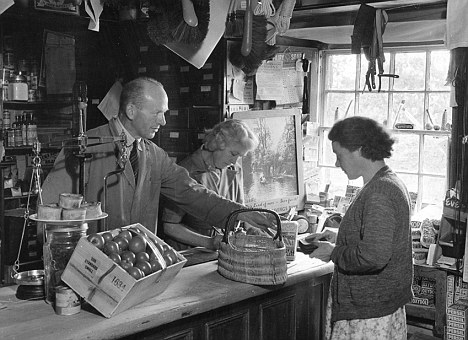
On the one hand, it’s creepy that the store could know you that well. However, my question stands – is that really all that different from “back in the day” when you might go into your local grocery store (the good ‘ole days when you had a relationship with your grocer) and talk to the owner who knows you and your needs. He takes you to the PB and notes the pro’s and con’s of each brand while offering you a deal on one particular one.

Image

Granted, one is big business and the other is local but based on personalized service alone, its actually very similar. Frankly, in a world of choices, it’s nice to have some information with which to make a decision. As someone who came into the internet age as a teenager, I like the idea.

Also, as a parent, the idea that I can hand my children a tablet on which they can happily watch Netflix while I shop?? Thank you. Really. Thank you.

Is that a fair comparison?

Back Pain and Soul Pain

General

There is a lie that floats about in our culture. It goes something like this – “healing has not happened (or worked) unless I do not feel pain any more.” As an Army prison chaplain, I experience it most in relationship to mental/spiritual anguish or “the dark night of the soul.” 

It goes something like this – the individual’s coping methods to dealing with pain land them in jail. They continue down this path (substituting alcohol, sex, drugs with ego trips, anger/rage, prescription meds) until they realize that they are still suffering greatly. They first reach out to mental health for relief and then, after realizing that drugs “won’t fix it” or that their counselor is encouraging them to work through their stuff reject it and show up in church. 

Here, they start reading the Bible furiously. Or, they start praying (at least in church) until something offends them at which time they either approach me about changing it or drop out all together. I challenge them on it and they say something like, “well, it didn’t take.” 

Another scenario that happens all the time is that someone will be the best Christian you ever met until they are denied parole. Then, clearly, God hates them and does not keep promises. (That they made to themselves on God’s behalf)

By the way, this is a common line of reasoning outside of prison too…

Which then introduces me mantra – people will not change until the pain of change is worse than the pain of staying the same. 

Somewhere along this path, they reach out to me for help. I introduce the above idea and say something like this, “I will not carry your burden. I cannot heal for you but I can and will join you and suffer with you if you want to really heal. You should know that it’s going to take you through some very dark waters. I’ll walk with you but not for you. I will be asking very hard questions and if you really want to heal, it’s going to be a little worse before it gets better. AND, it may actually NOT get better! In fact, your family might not be down with your growth and won’t like who you are becoming. You need to ask yourself if it’s worth the sacrifice.” 

Silence follows. 

Then a sigh and “I’ll give it a try.” 

Then we’ll enter into a pastoral care relationship. 

We explore the pain. We analyze why it’s painful. We struggle through how that pain might actually be a good thing and not something to be avoided. We seek to integrate it into life in a healthy way so as to not “cope” with it or avoid it but use it for positive growth. Those with enough courage hang in to the bitter end and experience great growth. Something people fall off. It happens. Either way, I’m there. Christ is there. 

What fascinates me on a regular basis is that the aforementioned lie is so prevalent in our culture. “Whatever you have to do to get rid of the pain…” 

What if pain wasn’t something to be avoided but embraced as God’s gift to guide you to healing? 

I heard this article on NPR this morning – loved it. It’s about managing back pain. 

“…along the way, she’s learning not to be afraid. “It’s learning not to fear the pain, learning that you can live with pain,” Wertheimer says. “Understand what that pain is, but then put it aside.”

In essence, sometimes the pain we experience both physically and emotionally is pain about the pain.

I teach my inmates to live with the pain, use the pain, make it a part of their spiritual strength and thus take away it’s power. 

“You will know the truth, and the truth will set you free.” – Jesus

Keeping Warm

thought of the day

I was looking for a good quote about being warm, first one I found, no kidding, was,

“The glow of one warm thought is to me worth more than money.” – Thomas Jefferson

But here’s the thing, if you have money, you can buy a space heater or just about any other way of conducting heat so…. You can have your warm thoughts. I want BTUs!!

Here’s another thought for this morning – on the warmth of friendship.

“Love is not just tolerance. It’s not just distant appreciation. It’s a warm sense of, ‘I am enjoying the fact that you are you.” – N. T. Wright

From Prov. 17:17 – A friend loves at all times, and family is born for adversity.

Bring the warmth of true friendship to someone today. Amen.

I love it when sports gives me the best illustration ever…

General

Disobeying a team rule.

Not an NCAA rule. Not a law. Not even a MSU rule. An undisclosed team rule.

It was for that, Coach Mark Dantonio benched his best player, his team captain, his undisputed leader of his tea. An undisclosed team rule.

That’s principled coaching.

I’ve been teaching the 7 Habits on the Inside (this is 7 Habits of Highly Effective People applied to prisoners living prison life) twice a week for 6 months now and once a week for over a year before that. It’s safe to day (as I am not deep into my 10th class) I am fully immersed in the 7 Habits lifestyle/program/cool aide…

Most basic to the program is living by principle.  Not living by indulgence, need, or want – principle. The idea that I know who I am, what I want, and what legacy I am leaving – I live to that. I live by my thought about, analyzed, tested principles.

This is why I loved watching the Spartans tonight. They played their football. The knowledge that they benched their best player on no less than the biggest game they have played for two decades, the 100th Rose Bowl, national television, Stanford. They benched their Player for an undisclosed team rule on the biggest game ever for everyone on that team.

That’s a principled team.

Then, there is Habit 2 – Begin with the End in Mind – living your life according to your vision. Seeing your legacy and then living according to that legacy rather than the one that comes by living out the default setting.

A year ago, Mark Dantonio walks on to the Rose Bowl field. Stands in the endzone and sees it all happening. His daughter captures the moment on a cell phone. He tells his team in the video that this is where they are going. A year before it happens, he stands on the field and sees it all before it takes place. Then, he takes his team there.

Vision.

Living by Principle and Vision.

Thanks Coach. I’m going to get a solid 20 minutes of great discussion out of this…

Post Christmas Feelings

thought of the day

My daughter was looking pensively out the window and my wife asked her what she was thinking, “Well,” she said, “sometimes Christmas just doesn’t feel the way I thought it would feel.” 

That happens sometimes doesn’t it. Sometimes, good things don’t entirely feel the way we thought it would feel or should feel or could feel. All those “coulds” and “shoulds” tend to just beat us up. Here’s the thing, Christmas is always best experienced in giving to others. The Holiday, at its best, celebrates the giving of the Divine to us humans. Thus, if a person really want to experience Christmas, it needs to get out of indulgence and into serving.
So, this, is Christmas.
“It is more blessed to give than to receive.” Not that there is not a blessing in receiving; it’s that the greater blessing comes through giving.

Out of the Closet

General

I like Musicals. Always have.

We went to watch Frozen the other day.

We then bought the soundtrack.

Its been playing almost as much as Christmas music in our house for the last three days.

I would say that I’m a great parent and willing to listen to my kids favorite music but that would not be accurate. I will own that when I was at work yesterday, I wrote a memorandum whilst “Let It Go” blasted from my computer speakers.
I love that song. I love that Sophie loves that song.

Today, while I was reading the news, she came up to me in a pokadot dress and said, “Will you dance with me?”

Maybe its the prison. I looked at her big eyes and had this vision of her growing up. I’m getting old and my kids are growing up.

Christmas Eve 9 years ago, I met Sara for real. We talked till Christmas Day. Now we have three children, survived two deployments, have lived in 7 different cities, and still in love. It’s a different love. A resilient love born of adversity. The best kind.

Huh, didn’t intend to get all introspective, I intended to write about what I liked about Frozen. Here it is:

There is this strange power that one of the sisters has. It comes out when she has strong feelings. Fear, anger etc. Her well-meaning parents, acting on the information they have, keep her hidden away, avoiding anything that would trigger emotions. They teach her to control her power by suppressing it.

What a metaphor for suppressing anger, pain, and other emotions! Her power is uncontrollable and dangerous because she never learned to manage it. I resonate strongly with this. Much of my pastoral care is helping people integrate suppressed emotions into their present in a healthy way. When we suppress stuff, its going to come out and if we don’t learn to experience our emotions in a healthy way, explosions are the natural consequence. The energy has to go somewhere!

Redemption comes in the story as the queen learns to experience both the positive and negative sides of her power in a healthy way. Everybody benefits. I love it.

And, I’ve always liked Disney musicals. And musicals in general. I was a music major in college and its not good to suppress that side of me…

On Things I don’t understand.

General

We’ve been reading “Charlotte’s Web” at night before bed. All the kiddos get teeth brushed, jammies on, and snuggled up in bed and I read another chapter from E.B. White. Tonight we read this – it’s from the chapter where Mrs. Arable is concerned that her daughter is going crazy, what with the talking to the animals in her uncle’s barn. The conversation drifts to the miracle of a spider’s web, “it’s a miracle” the doctor proclaims, “the spider is not taught and yet it can still make that web…”

Dr. Dorian: “Well, who taught a spider? A young spider knows how to spin a web without any instructions from anybody. Don’t you regard that as a miracle?

Mrs. Arable: “I suppose so. I never looked at it that way before. Still, I don’t understand how those words got into that web. I don’t understand it and I don’t like what I can’t understand.” 

Dr. Dorian: “None of us do,” said Dr. Dorian sighing. “I’m a doctor and doctor’s are supposed to understand everything. I don’t understand everything and I don’t intend on letting it worry me.” 

Exactly. Thanks for that E.B. 

Getting sucked into the Duck Disaster…

Peace, Theology

It wasn’t the interview. (I didn’t even know it was a thing until the memes started on my facebook feed. I don’t watch much tv and certainly not a show about rich people acting ignorant and poor when they are neither.)

It wasn’t what he said. (the man is entitled to an opinion and certainly free to share it)

It wasn’t him getting dismissed from the tv show. (the cable channel certainly have the right to retain those who represent their brand. Also, I don’t watch the show and have no attachment to it. If it was “Almost Human” on the other hand…)

It was the all the hullabaloo that started after. It was the perceived connection to religious freedom and the 1st Amendment right to free speech that got to me. It was the implication that somehow these statements about others (specifically African Americans and Homosexuals) represented Christ, Christianity and the Church.

They might represent Phil Robertson or maybe even his local church but they certainly do not represent me, my church, or my understanding of Christ.

Phil Robertson is my brother in Christ. We serve the same Lord. However, we might disagree on what exactly that looks like. And that’s ok. Frankly, the whole thing gave me opportunity to reflect on some things that are important to me. I like that about the internet and even Facebook. I did have a couple thoughts that I posted:

So… Here’s the thing. Freedom of speech is emphatically not the same thing as freedom from responsibility. The rich white guy certainly has the right to say what he wants and the rich entertainment company certainly has the right to fire him for it.
No one is losing their rights!!! They are just being held accountable.
Imagine that.

Followed by:

Also, before the band wagon really gets going, perhaps this could be considered,

– should a private company be forced to re-hire (or unfire) a person who publically disagrees with their principles and values and no longer represents what they are about?

Should churches be able to fire pastors who no longer agree with and represent their theology/principles/values???

Still a free speech issue?

Both interesting thoughts I probably would not have had apart from this silliness.

A kerfuffle like this tends to highlight just how differently Christians tend to experience and interpret their faith. Whenever this happens, we start to separate into groups, building walls, lobbing mortars at a perceived enemy.

Here’s the truth, we’re all still family. There is room in my family for Phil Robertson and Ray Boltz. Al Mohler and Gene Robinson. Mark Driscoll and Frank Schaefer.  Carlton Pearson and Ben Carson.

Our faith is big enough for all the family…. even the arguing cousins.

So, thanks GQ. Thanks Phil Robertson. May our Family be big enough for love…. and arguments…

Shame. Hope.

Sermon

Guilt. Shame. Church.

Do they go together ? Sometimes, it certainly feels that way.

Why is it that the Church uses those tools so much? Seems like every time I turn around, I am meeting someone who has experienced great hurt at the hands of the Church as a result of a very ungracious way of communicating guilt and shame.

Guilt is what we feel when we’ve done something wrong.  Guilt is sometimes deserved and sometimes not deserved.

Shame is what we feel when we are wrong. Shame is exposure. When what we’ve been trying to hide is exposed to others.

In the story of the nativity, guilt and shame are powerful players.

It begins in Matthew when Joseph discovers Mary is pregnant. 1:2. Seems that Mary was “found to be with child.” Discovered. Uncovered. Exposed. Shamed.

This is not just about Mary. In Matthew’s Gospel, she enters the story with this: there was a girl, promised to an honorable man named Joseph. They did not have sex. She was pregnant. She is discovered and now it’s Joseph’s problem. But Joseph is an honorable man. He is a just man. He doesn’t want Mary to be hurt.

Stop.

Listen.

The story of the birth of Jesus Christ, the opening story of a faith of untold millions in human history starts out talking about sex. Specifically, scandalous sex. There was this girl you see…

For shame.

This is not just about Mary. Marriage was a big deal in the ancient Mediterranean culture. Marriage is the glue that holds the culture together. Who your kids marries determines what kind of care you can expect in your old age. Having children gave you legacy and workers in your family business. Much of Mary’s young life was focused on her future husband and that choice was more about her family than her. What had taken place here was a negotiation between Mary’s father and Joseph’s father. There were certain obligations that needed to be met. Mary had no life of her own – she belonged to her father until her father gave her to her new Lord. The one who would care for her as she bore children to him. Joseph was obligated to provide for his parents in their old age. To do this, he needed children to work in the shop, learn the trade, grow and care for him through marriages that he would negotiate. This was not about love, this was about culture. Security. Continuity. The bride did not expect love, companionship, or comfort. This is a gender-divided world where men and women had little contact. Their union was arranged for the political or economic advantage of their families. If love grew from such a thing, it was a blessing though not necessary.

In America, we talk about marriage being the social glue that holds culture together but our ideas of marriage and their ideas of marriage are oceans apart. In ancient Palestine, Marriage held the social contract, the security of food and the passing on of necessary work. These were not wealthy people, they were just people living in a society. That society valued marriage in a way we cannot fully grasp. The whole process was a ritualized removal of Mary from her family. The groom’s father offers gifts, money, or services to the bride’s father to win the daughter for his son. The mother’s negotiate the deal to ensure that all is above board and fair. The bride’s father makes the ultimate decision. It sounds harsh to our ears but we are talking here about property. And community. And the security net the society depends on.

To be single is disastrous. Certainly for a woman.

To be single and have a bastard? Almost no other option excepting prostitution existed.

Discovered. With. Child.

I see Joseph pacing. “Does your father know? Really?? And he didn’t tell me?? This is not right!!”

Mary, sobs in the corner, “the angel… said I was highly favored… said I was going to…”

“STOP!! Just stop! You don’t even know what you’re saying! Will you add blasphemy to your harlotry??”

In the ancient Mediterranean world, people believed that unless prevented by appropriate measures, a man and woman who found themselves alone would inevitably have sexual relations. This is why the culture prescribes that men (fathers, husbands, brothers) watch, guard, and protect the women in their care.

There were a variety of strategies for accomplishing this protection. One was to ensure that there were always chaperones – woman, children – always around. The other was to structure the houses in such a way that there were inner rooms and courtyards that would prevent outside men from seeing the young girls. Again, if you are the father to a young woman in this time, protecting your daughter from violation is of paramount importance. You love your children, and they are your treasure. Literally. If this sounds like some Muslim cultures you have read about, you would be correct in seeing some similarities. Their world and our world are not the same.

Discovered to be with child. Calamity. When Joseph, their pious man, realizes, long after the rumors have been floating around, probably in the presence of her mother, that Mary is pregnant – they whole paradigm shifts in that moment. Trust is gone. Mary’s father had negotiated in good faith. Good faith! He guaranteed a virgin that would bear him many children. But this! This treachery. This betrayal! Someone needed to pay. He certainly had.

This was not just about Mary. This was about a system that had collapsed. Mary is betrothed. Our modern ideas about “engagement” do not capture the arrangement that has been made here. Betrothal was a family event rather than between individuals. Betrothal was the initial phase in a process in which the prospective spouses were set apart for each other. This had taken place years ago. The couple did not live together but a formal divorce was required to break the publically established betrothal. Any sexual relations outside of marriage was adultery. This was not a case of young love – this is adultery. Clearly, there is a problem. Perhaps her brothers had not cared for her. Perhaps her father had not protected her enough. Without the proper “tokens of virginity” after the marriage, her family would be shamed.

Joseph clutches his chest. Sinks to his knees. He was not ready for this. He’d never be ready for this. The girl he was promised huddled uncomfortably in the corner protecting her stomach, she was afraid. She was afraid of him. She was right to. He could have her stoned. Dragged into the street. Ruin her father and family.  They would never do business in this town again.

Now, Matthew, introduces the hero factor. Joseph is presented with two bad choices. He could expose this girl to death (Numbers 5:11-31) or return her to her father though divorce. He certainly does not want to take responsibility for a child that his not his!! Who would do that? The cultural honor code that society functions by, the “way things are” demand that he not let this stand. This child does not get to get away with messing that up. Regardless of her claims of supernatural conception.

But he is a just man. He does not want blood on his hands. He does not want to ruin this family. He does not want to be made out more of a fool that he is already been. People have been talking. Mary was not a part of the monthly ritual bathing. He knows that the rumor mill is in full operation. He is already tainted by this relationship – better to end it now, find someone worthy, and hope the whole thing is forgotten.

He makes plans for divorce. Not public shaming divorce but discreet and private divorce.

Isn’t it something that for all the stories of the birth of Jesus, Matthew chooses to start out this way? The lineage of Jesus through Joseph, a helpless girl, and a noble man.

It’s the stuff of great novels or rubbishy ones – depends on what you like to read I guess. Only, it’s not a novel and Joseph is a man plunged into a personal trauma he never wanted nor was prepared for.  He didn’t ask for this. He didn’t sign up for this. He certainly didn’t think he was up to the task of being “step dad.” His family was about to look not very normal.

Here’s the thing, we’re very good in our puritan culture of holding up a family system that we identify as “normal.” There’s a father, a mother, idealized kids, dog, picket fence, college, sports… the whole thing. When something comes along that looks different, even when we are witnessing redemption at work, sometimes, we let shame do our talking and condemn what doesn’t look right.

Until we’re the ones with the weird looking family system. Until we’re the ones with the kids from different parents and the baggage of divorce.

I have 7 adopted brothers and sisters. Several of them have handicaps that are quite severe. I grew up with a mantra – “what’s normal?” I mean really – what. is. normal?

The church seems to be really great at deciding and then spiritualizing what normal looks like. Jesus was not born into a normal situation. This was not lost on anyone and Matthew chooses to lead with it. Something very different is happening here.

All the traditional rules about the birth of a king are off. All the standards of lineage are broken. It is fascinating to me that Matthew spends all this ink laying out the Jesus bloodline and then saying – but that’s not how this one went down… there was this girl… betrothed to a man…

The birth of Jesus Christ is not about joy and happiness.  It does not seem to be too full of joyful anticipation. There is the journey of Mary to see Elizabeth. Seems a bit strange no? A young woman spirited away to another town visit with her Aunt in her “advanced maternal age…” Then there was the whole taxes thing and the long journey and the born in a barn… Not much about this birth is the way it’s supposed to be.

But look what it became.

Christmas is often like that. The season seems to highlight over and over again how life is not always played out the way it was planned. People are not where they are supposed to be. Plans didn’t turn out. Dreams didn’t pan out. Goals were not reached. Christmas is fun but can’t really hide the emptiness.

Not every Christmas is all tinsel and cookies. Not every birth is baby showers and cuddly blankets.

Joseph knows that feeling.

He carries through with the marriage out of duty. God tells him what’s going on, what’s expected of him, and Joseph responds immediately. No divorce. No putting away. This step-dad steps up to the plate and does what God has asked him to do. He does not choose shame and guilt. He does not walk away. He embraces and scandal and owns his calling.

This is why Christmas is so hopeful. Life is not always what we want it to be but there is hope. There is always hope.

It’s just a little officer pt…

Army, thought of the day

So there I was, a while ago, playing soccer for some friendly officer pt when I realized that the normal rules of soccer didn’t apply. Grrr. Frustration.

Here’s the thing. Soccer is my sport. I like it. I played it in college. I know the game. In a world of jocks (the Army) it’s the one sport I’m halfway good at. Thus, rules matter to me.

But only in the case of soccer. The rest… not so much.

Totally inconstant. I can own that.

There is a film called “Revolutionary Road” where one of the characters says No one really forgets the truth, they just get better at lying.”

This quote was highlighted to me on the day I lost my temper at our morning officer PT. There were some perceived injustices happening (again, I re-iterate that it was my perception) and this tapped a part of my personality that I don’t like. I like to think of myself as relaxed, removed, unflappable and easy going. Which is mostly true however what is also true is that I am a type A, driven, intense person who wants to win. I try really hard to keep all that in balance but sometimes it comes out in inappropriate ways and then I experience shame and guilt and embarrassment and all the stuff that goes along with exposing what I want to hide.

In some ways I think most of us have that. There are parts of us that we are not down with. We don’t really like. It triggers some embarrassment in us when it comes out. Authentic living integrates all the parts of who we are into our lives in a healthy way so that we are more holistic, healthy people who, instead of living out of our projected identity (that we have to go to great lengths to protect), live out of our authentic self – what you see and experience is who we are.

Leadership that rises from our core is the best leadership possible. The question to ask yourself today is, who are you really?”