Confusing hair metaphors

Theology, thought of the day

So, my daughter asked me this morning over breakfast:

“Dad, I’m wondering, if God loves you because of all of the hair on your head, how does that work if you are bald? I have a bald friend, (names him) and how does God love him if he has no hair?”

A fair question except my brain is still recovering from  my morning run so I stare at my coffee and she interprets that as needing more information.

“In Awana, it says in the Bible that God loves all of the hair on our heads..”

“Oh right. Well…” I go on to explain the verse and the idea of metaphors. Her response:

“Ok.”

Thankfully, my seminary-trained wife came in for the save. When she explained it, Sophie instantly got it. Go figure.

Oh the joys of explaining things to 6 year olds. #thanksawana

Hope (part two – from prison to the Tomb and beyond)

Sermon

Speaking of the afore mentioned hope

There was no such hope for the two women that approached the tomb that Easter morning. (Matthew 28:1-10) There was no comprehension that anything was going to happen outside of their own suffering. They had hope that Jesus was going to be some kind of king, that Jesus would bring some real change to the world they lived in. But that didn’t happen. After all the talk, all the prophecy, all the miracles, all the hype, Jesus came to Jerusalem and nothing changed.

Nothing changed. Nothing.

The Pharisees still walked to and from the Temple, praying on the street corner. The Sadducees still were the elite. The Sanhedrin still ruled in Jerusalem. Pontius Pilate was still procurator of Judea. The Romans were still the power. The Zealots were still on the run, still hiding. The disciples, for all their talk, were in hiding.

The world on that Sunday morning was still the same. Nothing had changed.

At least nothing they could see.

Actually, the world had changed. Resurrection had come.

Their hope was based in their reality. No matter how much Jesus had been with them, spoken to them, shown them miracles they couldn’t explain, their life was still profoundly attached to the reality they knew.

So they went to the Tomb. To sit. To remember. To think on what life had been for the last few years. To reset. To think about what to do next. To grieve.

There was no better tomorrow. There was only suffering. Today.

They had limited vision. They only saw God working in a way that made sense to them. We do the same thing with our hope, we put all our eggs in one basket and see God working in a way that makes sense to us. We know that it’ll work out because the Army will send us where we need to go, we’ll get that promotion, that family member will come around and see life the way I see it, time will start happening the way I want it to – I have hope but my hope is built around my life.

Only God does not work like that. We can’t make God work the way we want God to work. NO amount of hoping will make it so. God’s plan is not bound by a world that makes sense to me. Truth is, we have no idea what comes next. We can look to the past to reassure us that we’ll live, but then, the moment may still hurt.

So the hurting women came to grieve.

This passage plays out as a drama – there is an earthquake, the guards “become as dead men,” an Angel says “do not be afraid. Sometimes our salvation brings fear. We need our God to assure us that in the midst of it all, it’s going to be ok.

They were grieving and needed hope. They needed a vision for they were dying. They looked to Jesus for Salvation but that didn’t happen so they came to the Tomb to wait.

I’m wondering what they did with Jesus’ words. I wonder if, in those moments before the earthquake, they thought about what Jesus had said. That he planned on going to Jerusalem, where he would die and rise again. I wonder if they talked about what that would be like. I wonder if they believed it.

I wonder if they set their mind on the heavenly reality. I wonder…

The Apostle writes to the early Church, “So if you have been raised with Christ, seek the things that are above, where Christ is, seated at the right hand of God. Set your minds on things that are above, not on things that are on earth, for you have died, and your life is hidden with Christ in God. When Christ who is your life is revealed, then you also will be revealed with him in glory.”

We have the resurrection. They didn’t. We have the benefit of looking back on their reaction thousands of years later and wondering about them. They didn’t.

But the challenge of looking heavenward still remains.

Too often, our vision, our hope, is earth centered. It is human-focused. We see only what we want to see. We see only what we are looking at and when we do that, we miss what God is doing. We miss the possibilities in God. I wonder what I have missed because I only could see what I wanted to see. I wonder what you have.

Seek the things that are above…” Actively do it. Actively seek. Make it happen. Saints – where are you looking? What are you seeking?

I wonder if they had been seeking a risen Lord – would they have looked somewhere other than the Tomb? I wonder if we tend to look for God in the last place we saw God instead of a new place with the earnest expectation that God is present and alive, actively moving in this world – in our lives.

I wonder how much extra pain we end up with because we’re looking in the wrong place for a God who is doing something we don’t even imagine is possible.

This Easter – hope in God.

Look Heavenward. Seek heavenly things. Look for what God is doing and imagine what God might be doing beyond my reality.

So that you too might be able to say, I am in sorrow right now, but I know that I will make it.

For if God is with me, who can be against me?

Hope is stronger than memory.

Salvation is stronger than sin.

Forgiveness is stronger than bitterness.

Reconciliation is stronger than hatred.

The open tomb is stronger than the bloodied cross.

The Risen Lord is stronger than the dead Jesus.

We are the Easter people.

We are the people of hope.

We are the people of the empty tomb, the Risen Lord, the new life in Christ.

– Kennon L. Callahan, Ph.D.

Hope

Chaplaincy, Sermon

This last week, during counseling, one of my inmates made a profound observation about his life,

 “I know I’m going to make it, but right now really sucks.”

What a resilient statement. It’s a life-giving, hopeful statement. It’s based in reality. It is a recognition that he is full of sorrow and discouraged but, based on his past journeys through similar terrain, he knows that he’ll make it.

On the same day, Good Friday, I served Communion in the SHU. The SHU is the “specialized housing unit” 23 hour lockdown, solitary. Inmates end up there because they are having a difficult time getting along with others or obeying the rules. It is, by it’s nature, a depressing place. Inmates struggle back there. It is not a pleasant place to be. I put on my stole, filled individual communion cups, and took the trays into the SHU. The inmates are usually very respectful of my presence in there. They’ll stop their conversations and, particularly if I’m bringing communion, they’ll quietly prepare themselves for their turn.

The SHU becomes a sacred place. A place where God is present.

I move from cell to cell. The small feed tray is opened and I kneel down outside of it. Because of the low height of the open slot both myself and the inmate inside are in the kneeling position. Though a massive steel door separates us from one another, our faces are inches apart which creates a very intimate experience. Behind us, radios squawk, correctional specialist discuss what needs to be discussed, other inmates talk through their doors to one another, but in that sacred space between me and the inmate, God is there. I invite the inmate to confess whatever they need to God and then say amen out loud so I know to pray. When they are done (this can take a few seconds or even minutes as we kneel on the hard cement floor), I pray for them, myself, and the correctional staff. I thank God for the forgiveness promised in 1 John 1:9 and praise God for mercy and unmerited favor. I speak the words of institution:

“I will tell you the story as it was told to me, that the same night Jesus was betrayed, he took bread…”

We partake of communion together and end with the Lord’s prayer. Some of us have known each other so long now that they could recite the entire liturgy with me. When I finish, it is not uncommon for the inmate to have tears in their eyes. Yesterday, I ended with, “My friend and brother, it is Good Friday. Easter is Sunday. I’m so sorry that this will be your Easter.”

Over and over, they would say something like, “your right Chaplain, but God is here.”

Hope is so powerful. It can carry us though such hard times. It can give us strength to make it. It can endow us with the courage we need to see life as it is – tough, but we’ll make it. Hope is the very stuff of life.

When I hear hopeful statements like that, I am encouraged that growth is taking place. I am convinced that though it may be hard for them to experience it, they can see it in the Gospel. For that moment, that sacred moment, it’s going to work out.

Life is bigger than their suffering. 

How “Open and Affirming” has impacted my ministry thus far

Army, Chaplaincy

So, it’s not been quite a month since I posted my little sign on my door.

My emphasis on inclusivity has had an interesting, though anecdotal, impact on my pastoral care. I’ve noticed that those coming to see me have “gotten to the point” faster than in the past.

I don’t know if other chaplains or counselors have experienced this phenomena but it’s been true of my pastoral care wherever I’ve been a chaplain and even more so in prison. It goes like this: the individual requests an appointment. They come into the office and we spend significant time in the “joining process.” We talk about what we have in common, where we’ve served, likes/dislikes and theology. We do this gentle dance where I ask about what we’re there to talk about and they, passive/aggressively talk about everything under the sun but what they are really struggling with. I sense this, probe, and sense that they are not quite ready. It used to frustrate me but I’ve come to understand that it’s just their insecurities bleeding to the surface. If I try to rush it, it just gets worse. So, patiently, I wait till they trust me.

That’s the thing about trust – I can’t convince people that I am trustworthy – I can only be trustworthy.

This goes on for the majority of the hour then, after I note that it’s been a great talk and we can schedule another appointment – boom! Out it comes. The real issue. The deeper presenting problem. The shameful secret. Then, we’re out of time and I am in the position of choosing to address it or wait till next time.

Generally, I ask why it took so long. The answer is almost universal – they were concerned that I would judge them. That I would condemn them. That I would “think they were crazy.” It’s so normalized for me, I’ve come to expect it and plan for it in my pastoral counseling.

What I have noticed in the last month is that the “flash to bang” time has been less. Much less. I not only hung the sign on my door but also in the direct line of sight with those who sit in my office. There has been this neat moment when it catches their eyes and they read it. Silently. Take a deep breath and we get to the meat if the issue so. much. faster.

This last Sunday, I preached on the subject of how the Christian interacts with the world. I worked with the story of the Samaritan woman. I asked my congregation if Jesus judged the woman. Of course not. He said what was true for her but not in a condemning or humiliating way. He does not seem to have a need to call out her sin and make sure that she sees it. Of course, it is an assumption on our part that Christ considered the five husband thing a sin. He simply says what is true and she perceives that she is in the presence of a prophet.

Sometimes, we’re so intent on “taking a stand” and “calling sin, sin” that we miss out on the relationship that is forming. I challenged my prison congregation to focus on the “love the sinner” part and let the Holy Spirit take care of the sin part. I wondered what relationships we miss out on because we’re so committed to calling out the speck in our brother’s eye. I wondered what blessings we were missing out on because we refuse to interact with those whose charges we do not like or choices we do not approve of. I wondered what the “other” might have to say to us that would give us hope and encouragement but we were so bent on them “knowing where we stand” instead of just loving people for people’s sake.

I ended by reading my little sign.

After the service, (there were two) no less than ten different inmates wanted to know more about the Disciples of Christ and the response was overwhelmingly positive and affirming. In both services, inmates who know me and those who didn’t were coming up and thanking me. Clearly, it was water to thirsty souls.

O Church, how limited you can be sometimes…

Peace, Theology

The Church is in constant need of reform. Recently, a fascinating conversation took place on my facebook page about the Independent Baptist Church movement. I am a product of that movement. I went to those schools, I was trained in that hermeneutic and learned my homiletics there as well. Like most who leave an all-encompassing movement like that, I did so because of intense personal hurt. When I needed grace, I got law. When I needed love and acceptance, I got rejection and judgement.

As a chaplain and pastor now for well over a decade, I have come to realize that this phenomenon is common to all institutions in the Kingdom of God. Heck, it’s not even unique to the Kingdom! Its an institutional thing. I’ve watched it happen in the Army and in other types of organizations.

Just as predictable as the cycle is, so to is the reality that reformation will come along as those involved follow Christ. At it’s best, the Church is a community that provides encouragement and support for everyone. It’s the whole, “no difference between the Jew/Greek/Male/Female/slave/free idea. I was so angry for so long at fundamentalism. Now, I accept them for who they are. I hope they grow. I hope they experience grace. I am sad often when I experience them bound by their rigidity. It is no more fair for me to judge them for their paradigm (limited though it be) then it is for them to judge me for mine.

I’m a believer that there is room for ALL of us in the Kingdom.

That said, I do not have time or space in my life for mean people. And I’ve experienced mean people everywhere.

Christianity, at it’s best, will be about love and authenticity.

During my CPE residency, I was given this illustration. It was very helpful to me.

Imagine you needed 75 cents for a coke and you went to your dad for that 75 cents. He reaches into his pocket and produces 50 cents. He offers it to you. You get angry, 50 cents is not enough! You need 75. Your father gets angry and says, “but this is all I have, I don’t have any more!” Hurt and pain ensues. You keep demanding 75 and your father only has 50 cents. It’s all he can give. You storm off determined to find it elsewhere. Your father sighs and collapses into his chair, broken that he did not have what you needed.

Later, you realize this reality and give grace to your father. He gave you what he had.

It’s how I now feel about fundamentalism. It gave me what it had. Admittedly, it was not enough and I was so hurt in the process and I’ve seen others very hurt. I’ve also seen great good in people. They try hard. Perhaps they could do  more. But then, who am i to judge. People would not be fundamentalists if it did not fill a need (or assuage a fear) in their lives. I hope they experience some grace. At least, they will get it from me.

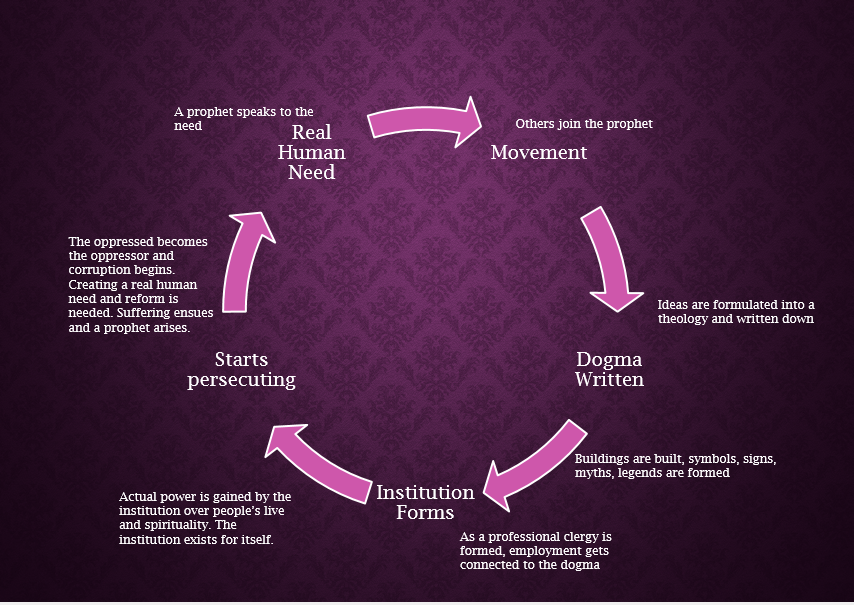
In the prison context that I currently minister in, I minister to unchurched and barely churched most of the time. I often get the question, “why are there so many denominations?” There are many answers to that question but last night I drew this on the board to illustrate how movements become institutions in need of reform become movements that become institutions in need of reform, become movements….

Cycle of the Church

I hope my children extend the grace I need someday when they are experiencing the limitation of my theology…

Try to listen.

thought of the day

In 1901, President Theodore Roosevelt invites African American Scientist Booker T. Washington to the White House for a visit. As is often the case whenever a president does something, there was immediate furor over whether or not it was appropriate for the president to do that. As many opined in the papers, a well-known African American scholar, Charles W. Chestnutt, wrote this in an essay entitled “Obliterating the Color Line” in the New York World:

“We sometimes underestimate the influence of little things; there is no more powerful a factor than sentiment in the conduct of human affairs.”

We do not go wrong by listening with empathy and extending understanding to those around us.

Coming Out as Inclusive.

Army, Chaplaincy, Open and Affirming

It would seem that a post about this would be completely unnecessary in the pluralistic world of the Army Chaplain Corps. It would seem that the directive to perform one’s own faith and provide for all the others would make such a statement redundant.

Only it’s not.

Somehow, this needs be said.

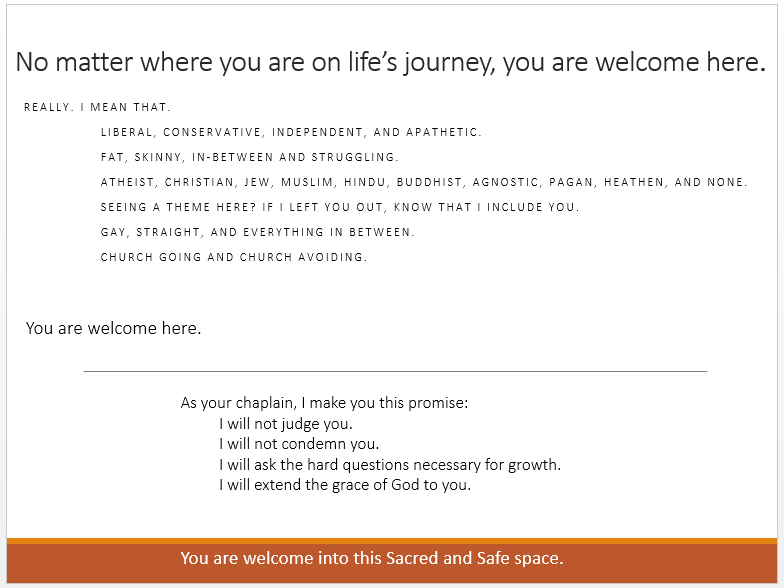
So, I am going to say it: I am a chaplain for ALL my Soldiers. All of them. The gay ones. The straight ones. The fat ones. The skinny ones. The conservative ones. The liberal ones. The religious ones. The non religious ones. The connected to church and the far away. The reason driven and the faith-based. The agnostic and the Christian. The pagan, the Muslim, the Hindu, the Buddhist, the whatever-you-happen-to-believe right now. Everyone I can think to mention and everyone else.

All means all.

This last summer, the General Assembly of the Christian Church (Disciples of Christ) voted to call all Disciples Congregations to be a welcoming people of grace to ALL God’s children. All is given as “race, gender, age, sexual orientation, gender identity, nationality, ethnicity, marital status, physical or mental ability, political stance or theological perspective.” Seems patently obvious but then, if we were all doing this already, such a statement would be unnecessary. This is my answer to that call.

A call given by my church but heard by me as a call from God.

I’ve been ministering in this way for well over two years now. I thought it sufficient to just ignore it and not really say anything. I thought it best to let people believe what they wanted about my ministry and be pleasantly surprised when they found out that I didn’t judge them (this is after they got the courage to come into the office for counseling). Over and over I heard my Soldiers, inmates, and family members vocalize that they didn’t expect me to be understanding. They would say something like, “frankly, I was worried about coming but you are different from other chaplains…” Still, I didn’t want to “put it all out there.”

“After all,” I reasoned, “if I make it too well known, I’ll just be labeled as the one who is “ok with the gays” and it’ll be all anyone thinks about when my name comes up. It’s just not that big a deal to me. I minister to everyone but surely, that’s a given.

Here’s the thing: I’ve met those with HIV because there was no safe place to identify as gay so they went to where they could and it was not safe. I have met those who ran from the church only to come to the Army for a sense of community and get rejected yet again. I’ve cried with those who finally say the words out loud, “I’m gay and I can’t tell anyone.” I’ve heard the stories about walking past the Chapel and in isolation, thinking about suicide but thinking there was no one inside who would help them.

It is not enough to just minister by word of mouth.

In a world where state legislators are literally passing laws that would allow them to refuse service to my fellow Soldiers (and everyone else) simply because of their orientation – it is not enough to be silent.

As a chaplain, I do not have a church to challenge with the Open and Affirming process, but I certainly can be exactly that – Open and Affirming.

I’m not saying this to be reactionary or a contrarian. I do not speak for anyone else but me.

I am saying this for the Soldier who is alone and thinks the world has rejected her because of who she is.

I am saying this for the Soldier walking by the chapel thinking that there is no one in there who can hear his pain and not judge him.

I am saying this for the spouse who, in shame, does not feel like he has anyone to turn to because of what he thinks about himself.

I am saying this for the parent whose gay child has just joined the Army and they are so worried that he’ll be abused for who he is.

I am saying this for the chaplains who also are “in the closet.” Truth is, they feel as I do but do not want to say it out loud and experience other chaplains reject them for interpreting Scripture differently from them.

I’m saying this for me. I’m saying this because if one of my children came out and was in the Army, I hope they would have a chaplain that would help them process what they are going through without judgment or condemnation.

I’m saying this for all those I have known, closeted and not, who have experienced great pain because the God they know and love is represented as doing the opposite.

From now on, this sign will hang on my door as a message to all the Soldiers, family members, and other chaplains I run across in my career – You are welcome.

Sign

How She is different from Me in the pulpit

General

As an aside to the last post here were a couple of differences between she and me in the pulpit:

1. When She was done with her kids sermon, she told the children to get their coats on before they went to children’s church.

2. She is short. Therefore, when standing on a stool in the pulpit, she totally owned that she stumbled a bit. Congregation laughed warmly. #wearweaknessasarmor

3. I wander, she stands still. Congregation appreciates not having to worry about preachers getting in their personal space.

4. She never once said, “Saint’s of God…” (in that oratorical sort of way)

5. She does not wear a robe as I do. Not because she doesn’t want to, just because they don’t make them in her size and she refuses to wear a child-sized choir robe. #whatiswrongwiththeworld

6. Totally owns knee high boots in the pulpit. Respect.

More to follow…

Hearing the Wife preach

Chaplaincy, Sermon, Two Pastor Family

Last Sunday, I heard Sara preach *in public* for the first time. It was perfect. It was not her first sermon, just the first time I got to hear her. One of the realities of being a two-pastor home is that we do not get to hear each other preach all the time. Sara often covers for me when I’m in the prison, so while I love that I have a dependable preacher every Sunday I am out of my civilian pulpit and in the prison, I also do not get to hear her preach. boo.

Sitting in the pew, I experienced pride, joy, anxiety, excitement. I’ve walked this journey with her for years. I remember our conversations about what to do as the kids grow up, how to pursue a career. One of the things that attracted me to Sara from the beginning is that she was not just about getting married and having babies. She was a strong, career minded woman even though at the time, she didn’t have the theological freedom to embrace that. I sensed that in her and it drew me. I remember exploring all these helping professions with her since it seemed that was the most logical but all of them fell short. She was not fulfilled. I wanted her to find her passion but didn’t know how to help her.

When she acknowledged God’s call in her life, it immediately made sense. It was the most logical, peaceful realization we have experienced together. I didn’t affirm her because she was my wife, I affirmed her because I immediately recognized the truth of her calling. Of course she was called to pastor. Of course!

When she called the kids to come forward for the children’s sermon and they all gathered around, snuggling in to a pastor who also was a mom, it was so right. When she took to the pulpit and began with a brilliant introduction about the elementary school pick-up line that drew the audience in to the text, it was so perfect. When she ended with solid questions and challenges – I watched the impact on our congregation – it was palpable.

Experiencing Sara in the pulpit for the first time confirmed once again to me that the God we serve is about the business of calling the best shepherds to guide the flock.

It was fun preparing the message. Since we have been in Matthew 5, we chose to do a mini series. I preached last week and Sara this week. What I loved about it was that we were able to take different perspectives on the same passage. Our congregation really enjoyed it as well. As we come into Lent, we are going to preach back to back through the season with the same goal.

I have noticed that we take very different approaches to preparing sermons. Sometimes that’s good and sometimes that’s challenging. I may have been preaching for much longer but that does not mean that I get to critique without leave…

I gotta tell you, this is getting fun!…

“dad, can I preach you a sermon I wrote?”

General

Sophia looked up with hopeful and expectant eyes. 

“Of course!” 

“Ok. Good morning. Why does Jesus love us? Why is the law? How does Jesus help us?”

As she asked these rather profound questions, she began pacing back and forth. The questions kept on coming. 

Questions and pacing. She, clearly, is influenced by my preaching style. 

Conclusion? Jesus helps us keep the Law. 

There’s even some great theology in there… 

Here’s me just proud to be a dad of a six year old daughter who spent time writing her very own sermon.